
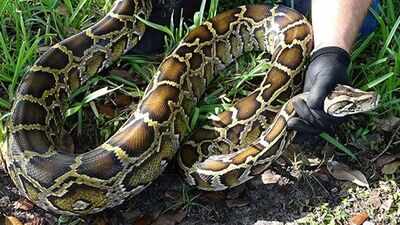
When a district in Florida’s Everglades used robot rabbits to eliminate its ever-growing population of Burmese pythons
Florida held its annual Python Challenge just a few weeks ago. The 10-day competition brings together professional and amateur hunters to track and remove invasive Burmese pythons from the Everglades, with cash prizes awarded for capturing the most snakes and the longest python. While the event remains one of the state’s biggest efforts to control the invasive species, officials are increasingly turning to technology to find snakes that often remain hidden, and the state continues to battle its growing population of Burmese pythons.Last year, the South Florida Water Management District turned to an unusual technology after the annual Florida Python Challenge: solar-powered robot rabbits. Explaining the initiative, the district said in 2025, “Scientists from the South Florida Water Management District (District) and the University of Florida have teamed up to use robotic rabbit decoys as part of our continuing efforts to combat and remove invasive pythons.” Designed to mimic real rabbits using artificial intelligence (AI), heat-signature and scent-simulation technologies, the devices lure pythons out of hiding and alert officials when a snake is detected.
How AI-powered robot rabbits work
Unlike traditional wildlife monitoring tools, the robotic rabbits are designed to imitate real prey. The solar-powered, remote-controlled devices produce both a heat signature and a scent intended to attract Burmese pythons, which rely on thermal sensing and smell while hunting.Each robot is equipped with an AI-powered camera that continuously monitors its surroundings. When the system detects a python approaching, it automatically alerts officials at the South Florida Water Management District. A trained python removal agent is then dispatched to capture and remove the snake.According to the district, the robots are strategically deployed across South Florida at locations where pythons are known to hide, allowing officials to monitor areas that are otherwise difficult to survey.
Why Florida is targeting Burmese pythons
The robot rabbits are the latest addition to Florida’s long-running efforts to control Burmese pythons, which were introduced into the wild decades ago and have become one of the Everglades’ dominant invasive predators.Conservationists estimate there are between 100,000 and 300,000 Burmese pythons across Florida’s subtropical regions. Adult females can lay more than 70 eggs in a single clutch, while the snakes can grow to more than 18 feet long.According to the South Florida Water Management District, invasive pythons prey on native mammals, birds and reptiles, reducing food sources for species including Florida panthers, bobcats and birds of prey.The impact has been documented by the US Geological Survey, whose 2012 study found raccoon and opossum populations in parts of the Everglades had declined by nearly 99% following the spread of Burmese pythons.
How the robot rabbits complements annual python hunt
Before deploying robotic rabbits, Florida primarily relied on trained contractors and public participation through the annual Florida Python Challenge.The 10-day competition brings together professional and amateur snake hunters to remove invasive pythons from the Everglades. Participants must complete a safety course before taking part, and all captured snakes must be euthanised using methods approved by the Florida Fish and Wildlife Conservation Commission.More than 600 people had registered for this year’s challenge before it began, while over 900 local and international competitors participated in this year’s event.According to the South Florida Water Management District, more than 19,000 Burmese pythons have been removed from the Everglades since 2000 through state removal programmes and public initiatives. Last year, the district said the robotic rabbit programme is intended to complement those efforts rather than replace them.“These innovative robots produce a heat signature and emit a smell designed to attract pythons. The robots are equipped with cameras that monitor for pythons and notify District officials when a snake is detected. Once notified, the District can dispatch a python removal agent to the area,” the district noted.